MON - FRI: 08:00 - 05:00 PM
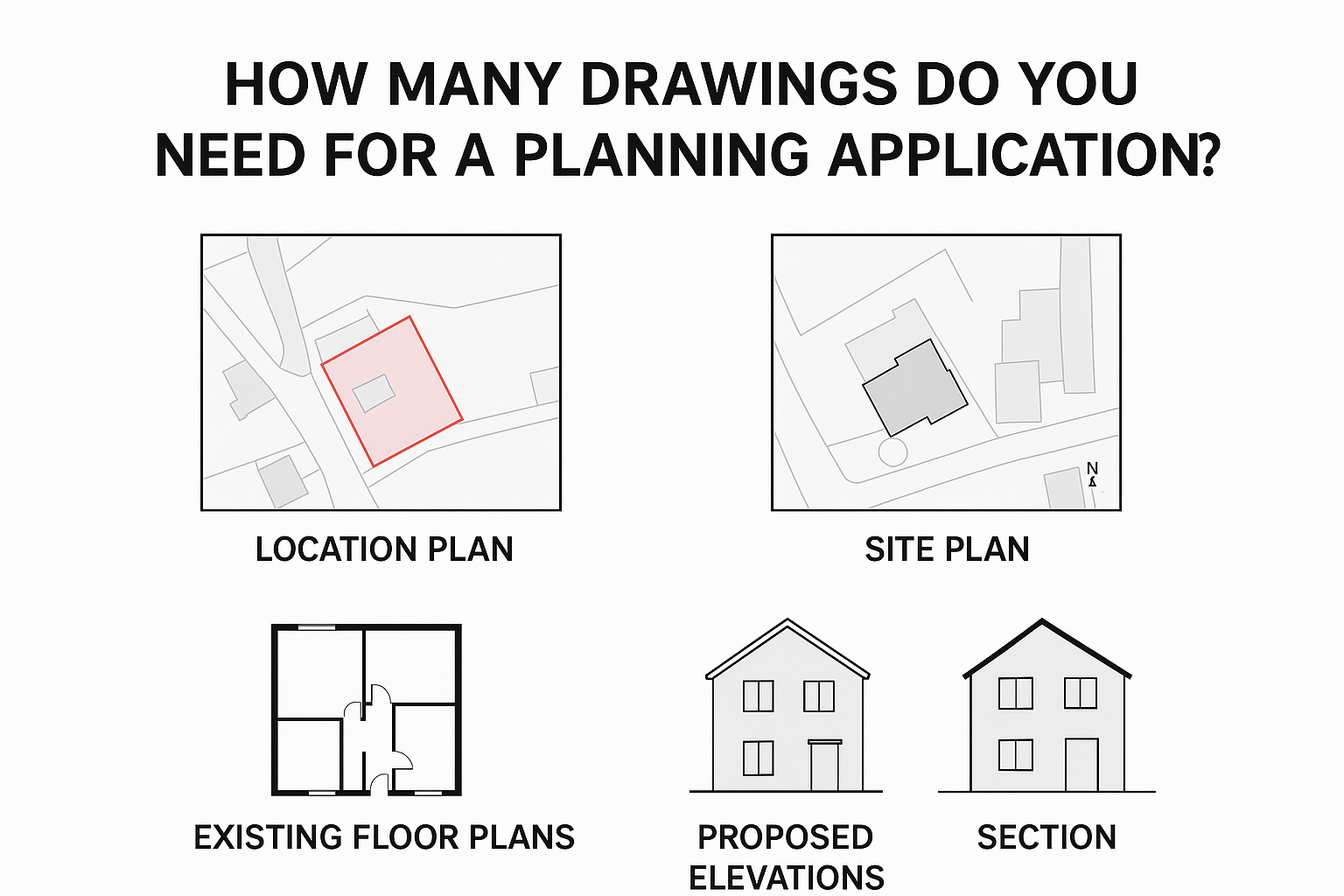
How Many Drawings Do You Need for a Planning Application?
One of the most common questions clients ask is, “How many drawings do I actually need for my planning application?” It’s an understandable concern. Submitting the right set of drawings can feel daunting, especially if you’ve never navigated the planning system before. The truth is that the number—and quality—of your drawings can make a substantial difference to how smoothly your application progresses.
While requirements can vary between local authorities, most UK planning applications follow a broadly consistent structure. In this article, we’ll break down exactly what you need, what each drawing is for, and how we at Steve Jackson Design ensure that your submission is clear, compliant, and compelling.
Why Drawings Matter in the Planning Process
Planning drawings aren’t just technical documents; they’re the language planners use to understand your proposal. They must communicate the existing site conditions, the proposed changes, and how everything fits into its context. Good drawings anticipate the questions a planning officer may have and answer them before they’re asked.
At Steve Jackson Design, we’ve seen firsthand how comprehensive, well-organised drawings can significantly improve approval rates. Planners appreciate clear information—and clarity starts with presenting the right set of drawings.
1. Location Plan
A location plan shows where your site sits within the wider area. This is usually drawn at a scale of 1:1250 or 1:2500 and highlights your property boundary within its immediate surroundings.
It might seem like a simple map, but it serves an important purpose: it anchors your application geographically and confirms that the authority is assessing the correct site. A location plan is required for almost every planning application, no matter the size.
2. Block Plan / Site Plan
Next is the block plan, also known as the site plan. This focuses more closely on your plot and shows how the proposal relates to neighbouring boundaries, buildings, trees, roads, and access points. The standard scale for this drawing is 1:500 or 1:200.
At Steve Jackson Design, we put particular care into this drawing because it often influences key decisions about overlooking, overshadowing, parking, and drainage. It provides the planner with an at-a-glance understanding of how your site functions.
3. Existing Floor Plans
Before you can propose changes, you must document what currently exists. Existing floor plans show the internal layout at present and establish a baseline for any alterations.
Clients sometimes ask whether these can be skipped for smaller projects, but the answer is almost always no. Planners need to compare “before” and “after” to make a fair assessment. We prepare existing plans at a consistent scale—usually 1:100 or 1:50—to ensure a clean comparison with proposed plans.
4. Proposed Floor Plans
Proposed floor plans show the intended changes clearly and simply. They must align perfectly with the existing plans in terms of scale, orientation, and detailing.
At Steve Jackson Design, we focus on clarity over complexity. The goal is to illustrate the transformation without clutter. Whether you’re adding an extension, reconfiguring the interior, or undertaking a full remodel, the proposed plans form the backbone of your application.
5. Existing Elevations
Just as planners need existing floor plans, they also need to see the building’s current external appearance. Existing elevations show all visible sides of your property and highlight surrounding context such as neighbouring rooflines or changes in ground level.
These elevations help establish the visual character of the existing property—an important factor when assessing whether the proposed design is sympathetic to its surroundings.
6. Proposed Elevations
Proposed elevations illustrate how the building will look after the changes. These drawings show materials, openings, roof forms, extensions, and any alteration to massing or scale.
We find that clear elevations can often be the most influential visual aspect of an application. They help the planner quickly understand whether the proposal enhances or detracts from the local streetscape. At Steve Jackson Design, we pay close attention to proportion, alignment, and consistency to ensure your design is both aesthetically strong and planning-friendly.
7. Section Drawings (Often Required)
While not always mandatory, section drawings are increasingly requested by planning departments—especially for larger extensions, loft conversions, or projects involving varying ground levels.
A section cuts through the building to show internal heights, roof construction, stair positions, and spatial relationships. They are extremely helpful in demonstrating how new spaces will feel and function.
We typically include sections proactively because they reduce the likelihood of planners requesting additional information later, which can delay the process.
8. Roof Plans (Sometimes Required)
Roof plans aren’t always necessary, but they are valuable for complex rooflines, dormers, or projects involving height changes. A clean roof plan can clarify how different forms interact and ensure there is no confusion about the design.
9. Additional Drawings for Specialist Projects
Depending on your project, additional drawings might be required, such as:
-
Site levels and contours
-
Visibility splays for access alterations
-
Landscape or planting plans
-
Heritage impact drawings (for listed buildings or conservation areas)
When you work with Steve Jackson Design, we identify these upfront so nothing is overlooked later in the process.
So, How Many Drawings Do You Need?
For a typical house extension, you’ll usually need 8–12 drawings:
-
Location plan
-
Site/block plan
-
Existing floor plans
-
Proposed floor plans
-
Existing elevations
-
Proposed elevations
-
Sections (if required)
-
Roof plan (if required)
More complex projects may require additional documents, but the core principles stay the same.
Submitting the right set of drawings means that you are presenting a clear, cohesive vision. At Steve Jackson Design, our priority is to create drawings that tell your project’s story in a way planning officers understand and appreciate.
If you need help preparing planning drawings or want advice on a specific project, we’re always happy to help. We design a huge and varied range of residential projects from new-build, extensions, conversions, to major refurbishments.
- Category :
- Type :